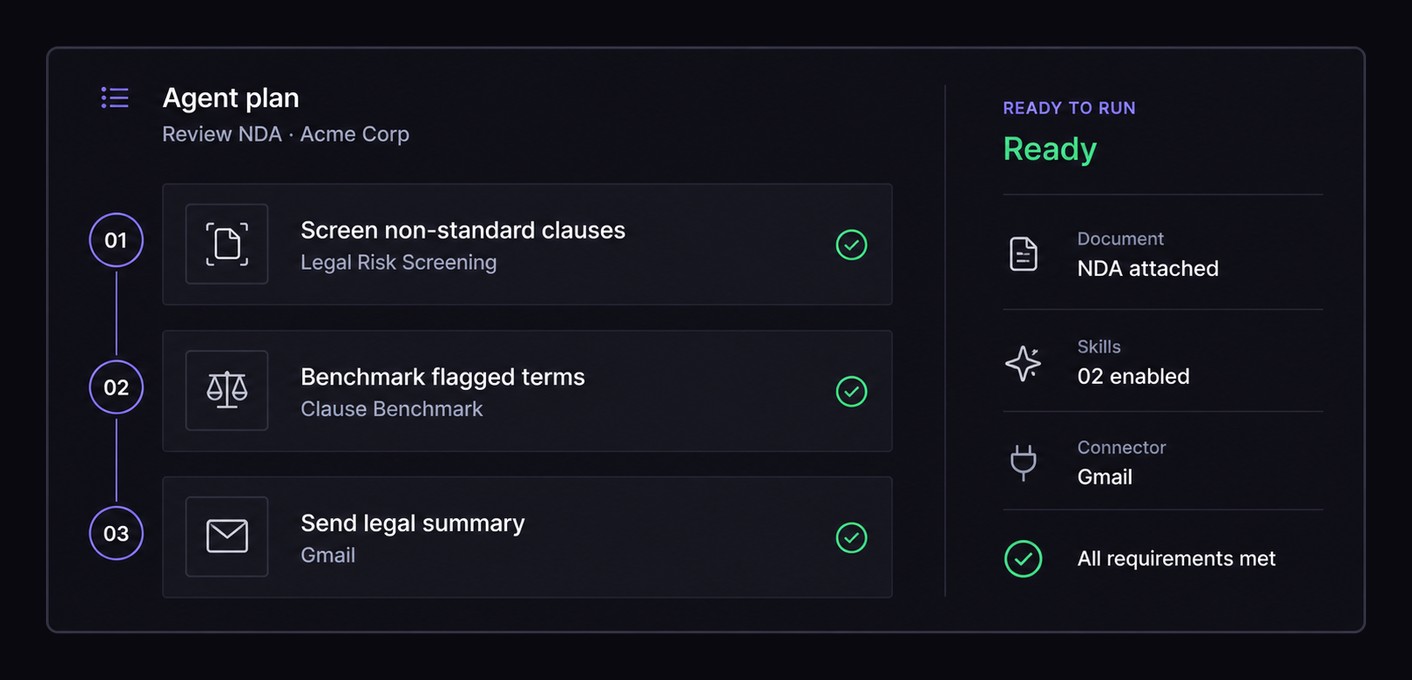
Describe what you need. The agent breaks it into steps, pulls the right skills and connectors, checks every requirement, then executes, with each action authorised before it runs.
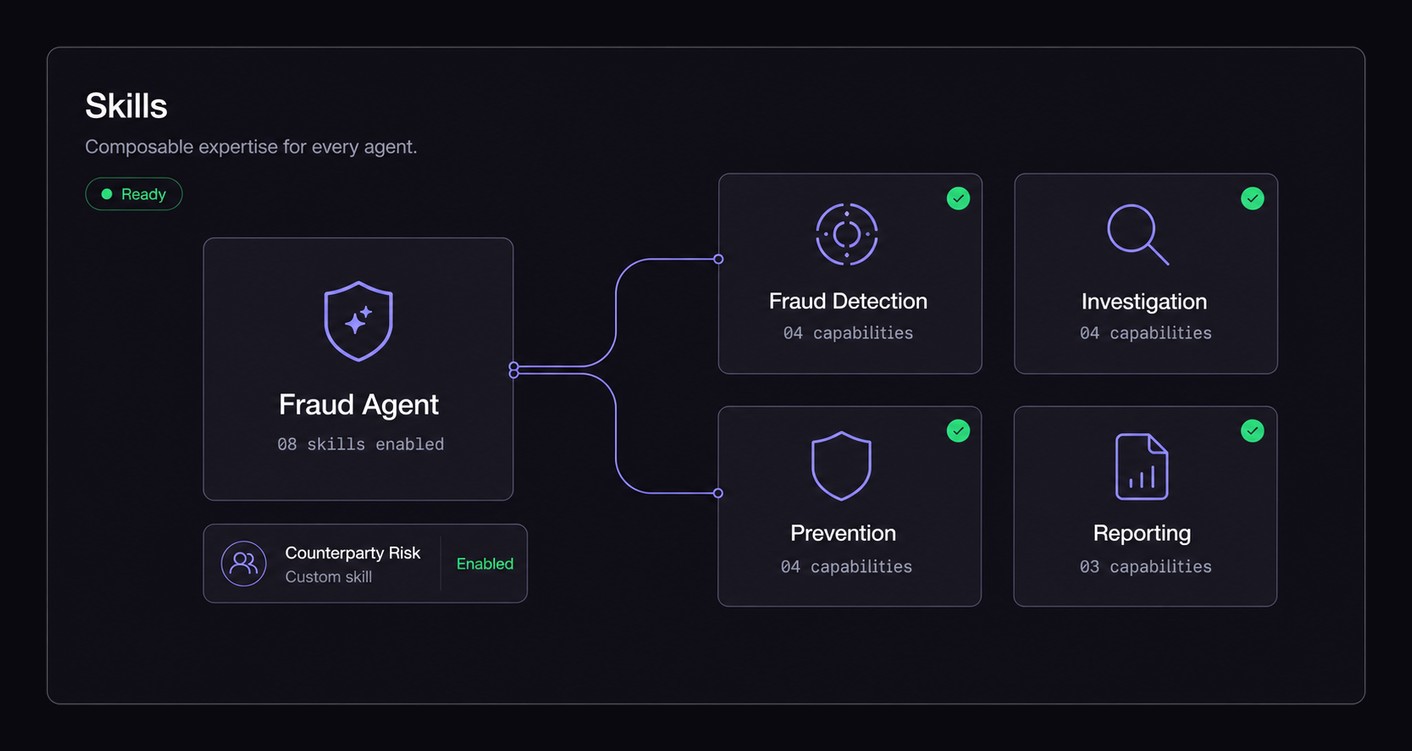
No fixed toolset. Agents compose reusable skills for the task in front of them, and build new ones when they need to. Every skill runs under the authorisation layer, so new capability never means new risk.
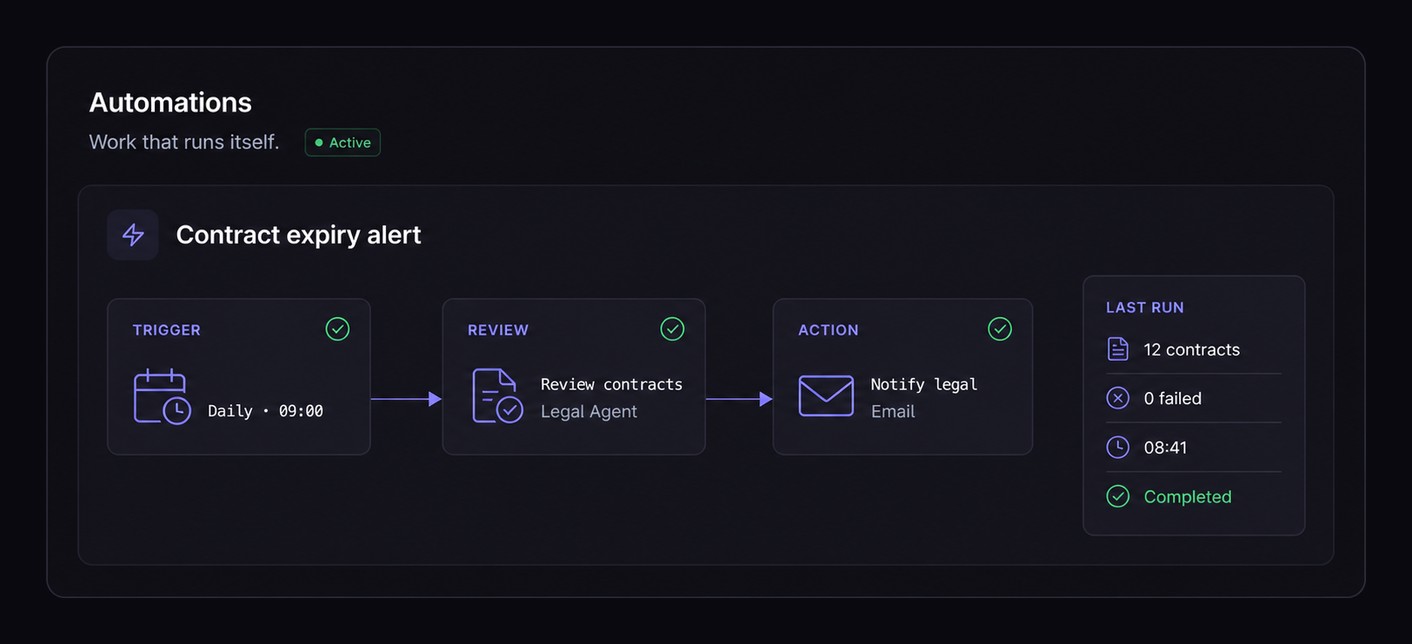
Turn any workflow into an automation that triggers, reviews, and acts on its own. High-stakes steps pause for a human, everything else runs untouched, and every run is sealed to the vault.
The same authorised agent adapts to your domain. Point it at a task, it builds the skills it needs and runs it, start to finish.
Screen NDAs, flag non-standard clauses, and draft summaries, every action traced to its clause.
Match transactions, surface anomalies, and prepare reports within signed limits.
Run sanctions and PEP checks, watch for rule changes, and seal audit evidence automatically.
Handle incoming work, execute standard playbooks, and pause for a human only when it matters.
Enrich accounts, draft outreach, and update records, with every send authorised.
Answer requests, summarise long threads, and route to a person with full context.
Most platforms bolt governance on after the agent acts. We built the authorisation layer first, then built agents on top of it.
Agents run on the authorisation layer. Nothing touches money, data, or another agent without a verdict first.
Agents compose and create their own skills for the job, so you are never blocked waiting on a connector.
Agents plan, act, and automate independently, with a signed record of every decision sealed to the vault.
Skills to do the work, automations to run it, connectors to reach your systems, and a channel to reach you, every action authorised.
Put one workflow on an authorised agent. It plans, builds the skills it needs, and runs, with every action authorised and sealed.
Give the agent an outcome and it plans the work. It breaks the task into steps, selects the skills and connectors each step needs, checks that every requirement is met, then executes, with each action authorised before it runs.
Before it starts, the agent confirms it has the documents, skills, and connectors the plan calls for. If something is missing, it asks rather than guesses. Nothing runs until the plan is ready and cleared.
The plan is not a single opaque call. Each step is a discrete action that passes through the authorisation layer on its own, so a plan can run far while a single risky step still pauses for a verdict.
| Input | An outcome, in plain language |
| Output | A step-by-step plan |
| Skills | Selected automatically |
| Connectors | Attached per step |
| Requirements | Checked before the first step |
| Authorisation | Per action, at intercept |
| High-stakes | Pauses for a human |
| Visibility | Every step and status shown |
| Record | Sealed to the vault |
Agents have no fixed toolset. They compose reusable skills for the task in front of them, and build new ones when they need to. Every skill runs under the authorisation layer, so new capability never means new risk.
A skill is a scoped, reusable capability. Agents assemble the ones a job needs, and can create a custom skill on the fly. Each still passes through the same checks as any other action.
Because agents build the skills they need, you are not blocked waiting on a connector or a release. New skills are versioned, shareable across agents, and always run inside the authorised box.
| Type | Composable, reusable |
| Creation | Agent-built when needed |
| Scope | Authorised per action |
| Reuse | Shared across the fleet |
| Versioning | Tracked and rollable |
| Boundary | Runs under the authorisation layer |
| New capability | No new standing authority |
| Record | Each skill run sealed |
Turn any workflow into an automation that triggers, reviews, and acts on its own. High-stakes steps pause for a human, everything else runs untouched, and every run is sealed to the vault.
An automation is a trigger plus a sequence of authorised steps. It can run on a schedule or an event, wait for a verdict at the risky moments, and report each run as a signed record.
You can pause, resume, or revoke an automation, and every run leaves a receipt. A misbehaving automation is stopped at the layer, not just logged after the fact.
| Trigger | Schedule or event |
| Steps | Review, then act |
| Human review | On high-stakes steps |
| Authorisation | Per action |
| Controls | Pause, resume, revoke |
| Kill switch | Enforced at intercept |
| Record | Each run sealed |
| Alerts | Streamed to your stack |
 Xybern