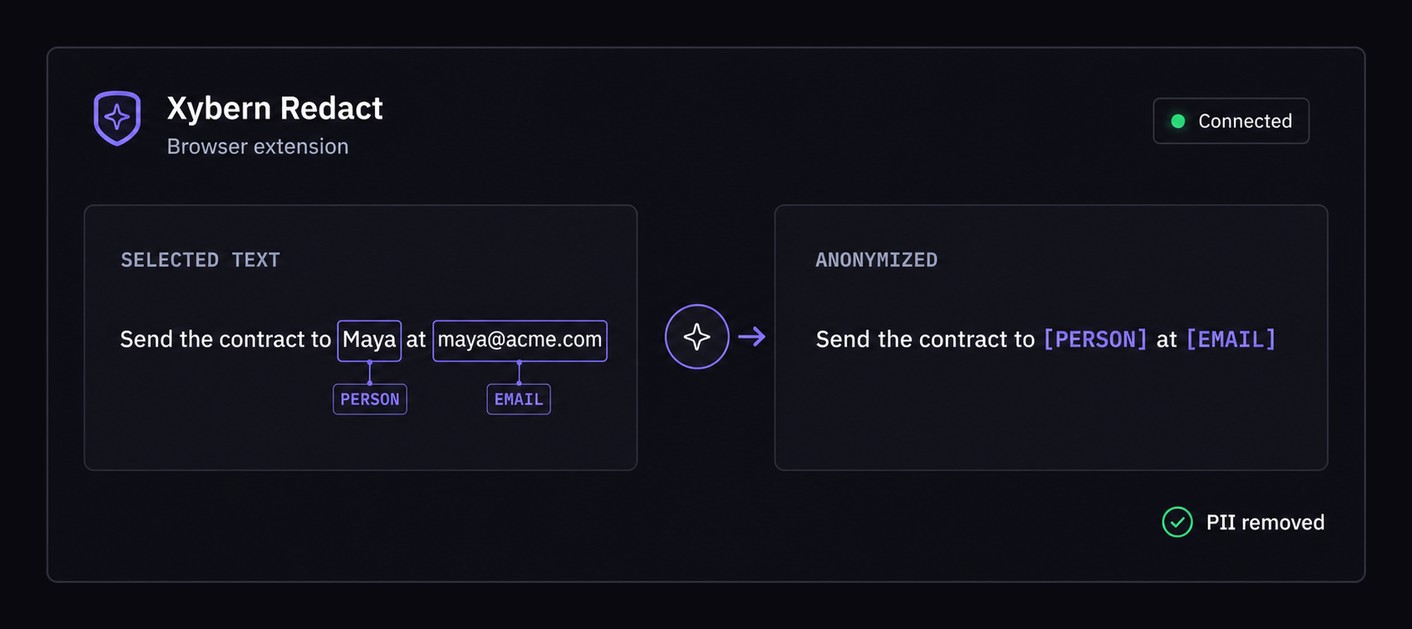
Xybern Redact sits between your people and the model. It finds the personal data in a prompt, replaces it with typed placeholders, sends only the anonymised text, then restores the real values in the reply. The model, and its provider, never see the raw data.
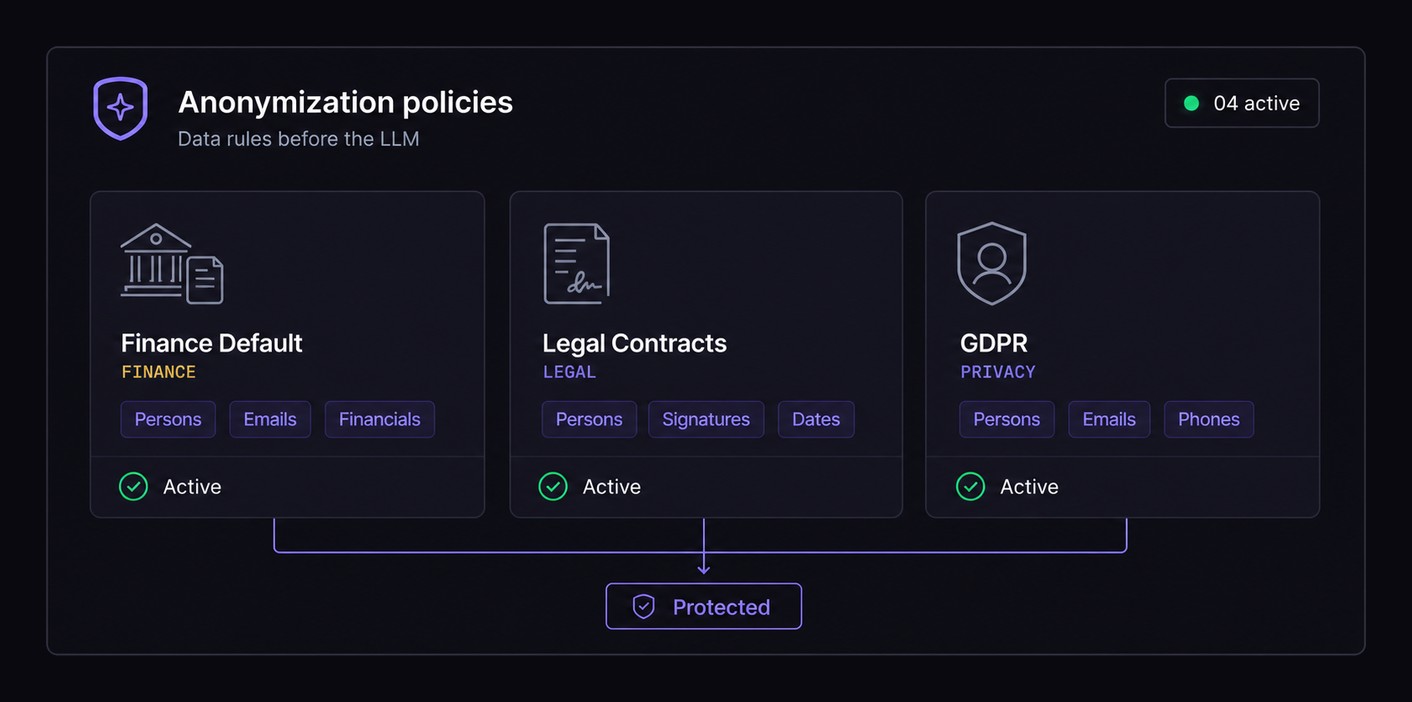
Choose what counts as sensitive with reusable policies. Finance, legal, and GDPR templates strip the persons, emails, financials, and signatures that matter to you, applied the same way to every prompt, from every tool.
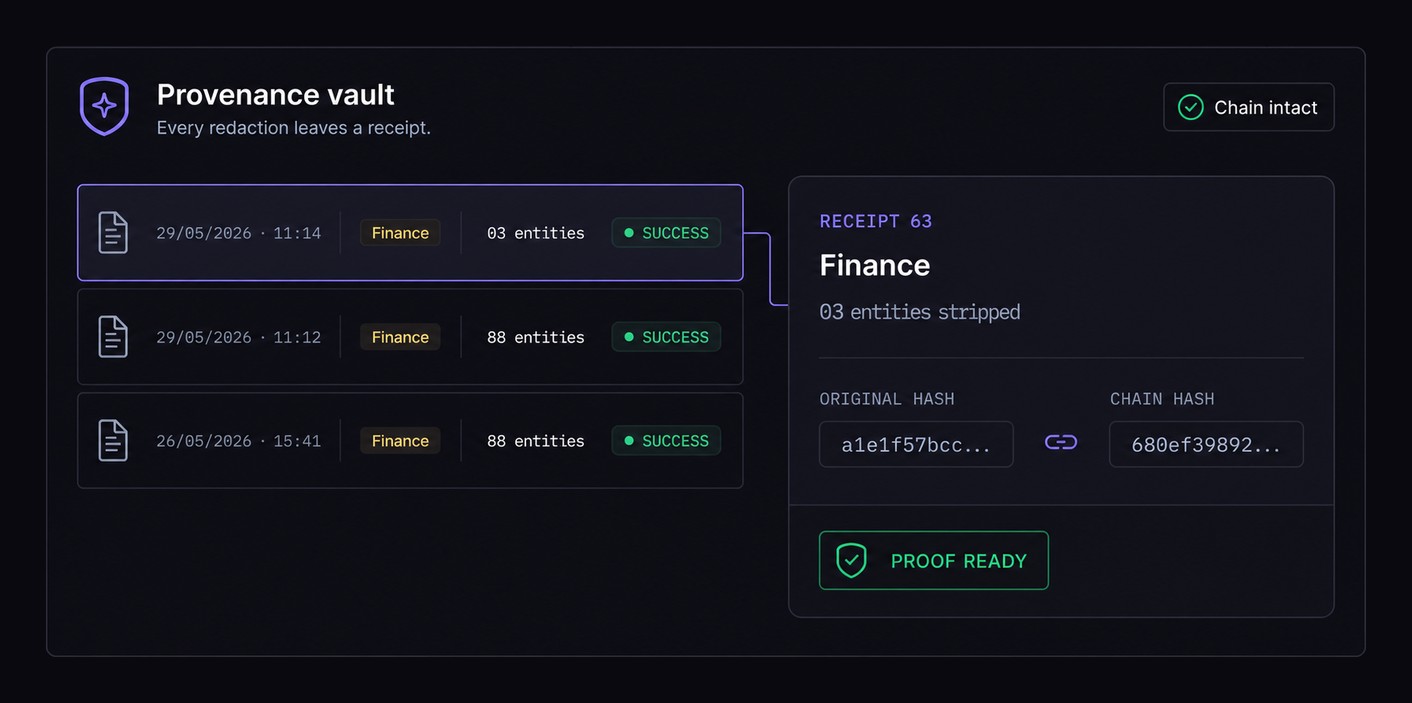
Each anonymisation is sealed with the entities it stripped and a hash chain. You can prove what was hidden, and when, without ever storing the raw values in the clear.
One layer, in the browser, in front of your models, and over your documents. No prompt changes, and no new habits.
Redact inside ChatGPT, Claude, and any web app, before a prompt is ever sent.
Point your endpoint at Xybern. One base URL, no code changes, every call anonymised.
Upload a document and get it back with the personal data removed, ready to share.
OpenAI, Anthropic, or your own model, the provider only ever sees anonymised text.
The personal data is gone before the prompt leaves your control, and every redaction is provable after the fact.
Personal data is removed before the prompt reaches the model, so no third-party AI ever sees it.
The real values return in the reply. The mapping stays with you, never with the provider.
Each anonymisation is sealed with the entities removed and a hash, so you can prove it later.
A drop-in anonymisation proxy, policy templates, a live preview, and a PII risk score, the pieces that keep personal data out of the prompt.
Put one workflow behind Xybern Redact and watch every prompt leave anonymised, every reply come back whole, and every redaction sealed.
Xybern Redact sits between your people and the model. It detects personal data in a prompt, replaces it with typed placeholders, sends only the anonymised text, and restores the real values in the reply.
The same redaction runs in the browser extension, in a proxy in front of your models, and over the API, so a prompt is anonymised no matter where it starts.
Each entity becomes a typed token, [PERSON], [EMAIL], [IBAN], so the model keeps the shape and meaning of the text while the real value stays with you.
On the way back, placeholders are swapped for the real values, for the person allowed to see them. The provider never holds the mapping.
| Surface | Browser, proxy, or API |
| Detects | Persons, emails, financials, more |
| Replaces | Typed placeholders |
| Restores | In the reply, for the right people |
| Provider sees | Anonymised text only |
| Detection | Runs before the call |
| Cost | Milliseconds per prompt |
| Mapping | Held by you, never the provider |
Choose what counts as sensitive with reusable policies. Finance, legal, and GDPR templates strip the entities that matter to you, applied the same way to every prompt.
Start from a template and adjust, or build a policy from scratch. Each policy names the entity types to strip and the surfaces it applies to.
Policies run at the point a prompt is sent, so the rule is the same for every tool and every person, with nothing left to individual judgement.
Assign a policy to a team or a workspace, so finance, legal, and support each strip exactly what their work requires.
| Finance | Persons, emails, financials |
| Legal | Persons, signatures, dates |
| GDPR | Persons, emails, phones |
| Custom | Any entity set you define |
| Applied | Before the model call |
| Assigned | Per team or workspace |
| Active | Enforced on every prompt |
Every anonymisation is sealed with the entities it stripped and a hash chain, so you can prove what was hidden, and when, without ever storing the raw values in the clear.
Each redaction writes a record: the policy, the count and types of entities removed, a timestamp, and a hash linked to the entry before it.
The record proves a redaction happened and what class of data it covered, without keeping the personal data itself. There is nothing sensitive to leak.
Verify the chain on your own and export a scoped pack for audit, one redaction, a period, or a whole workspace.
| Contents | Entities stripped, timestamp |
| Chain | Hash-linked to the prior entry |
| Raw data | Never stored in the clear |
| Proof | Receipt, offline-verifiable |
| Signature | ECDSA P-256 |
| Chain | Tamper-evident, append-only |
| Export | Scoped proof pack |
 Xybern